Speech therapy exercises are structured activities that help children and adults improve articulation, language skills, and oral motor function. These evidence-based techniques range from simple repetition games to complex breathing exercises, designed to strengthen speech muscles and build communication confidence through engaging, clinically supervised practice.
- Emerson College - Master's in Speech-Language Pathology online - Prepare to become an SLP in as few as 20 months. No GRE required. Scholarships available.
- Arizona State University - Online - Online Bachelor of Science in Speech and Hearing Science - Designed to prepare graduates to work in behavioral health settings or transition to graduate programs in speech-language pathology and audiology.
- Pepperdine University - Embark on a transformative professional and personal journey in the online Master of Science in Speech-Language Pathology program from Pepperdine University. Our program brings together rigorous academics, research-driven faculty teaching, and robust clinical experiences, all wrapped within our Christian mission to serve our communities and improve the lives of others.
- Aurora University - BS Communication Sciences and Disorders program - Discover how to transform lives by identifying and treating communication disorders for people of all ages. You’ll gain hands-on experience while fulfilling requirements toward graduate education.
- Arkansas State University - Dyslexia Certificate - Build upon your teaching expertise by adding a specialization in dyslexia with their Dyslexia Certificate online program.
- Eastern Oregon University - Master of Science in Education with a specialization in Dyslexia - Provides an advanced study of best practices and applications for PK–12 contexts with a specialization in Dyslexia.
- The University of West Alabama - Master of Education in Dyslexia Therapy - Enter an emerging field to support students with dyslexia and related reading challenges by earning your MEd in Dyslexia Therapy degree.
The practice of speech-language therapy is a challenging, often demanding profession that requires professionals with a master’s level education, a post-graduate fellowship, state licensure, and, more often than not, national certification. Their advanced level of education and training qualifies them to assess, diagnose, and treat a wide array of speech, language, swallowing, and communication disorders.
It’s important work, for sure, but ask any speech-language pathologist (SLP), and they’ll likely tell you it’s also pretty rewarding. After all, it’s one of just a few professions that combines evidence-based clinical practice with creative, engaging therapeutic activities that make real differences in patients’ lives.
Important Medical Disclaimer: The exercises described in this article are educational examples for SLP professionals, graduate students, and supervised clinical practice. Always consult a licensed speech-language pathologist for proper assessment and individualized treatment plans. Never implement these exercises without professional supervision, especially for children with diagnosed speech, language, or swallowing disorders. These activities supplement, but never replace, professional speech-language therapy.
Table of Contents
What Are Speech Therapy Exercises?
Speech therapy exercises are structured, evidence-based activities designed to improve speech clarity, language comprehension, oral motor function, and communication skills. When delivered by licensed speech-language pathologists, these exercises target specific areas of communication difficulty through repetitive, progressive practice that strengthens the neural pathways and muscle groups involved in speech production.
Informal, personal interactions marked by focused speech-language exercises are at the heart of speech-language therapy. These structured techniques serve as essential tools for encouraging speech and language development in children and maintaining or recovering communication abilities in adults following injury, illness, or neurological changes.
The most effective speech therapy exercises share several characteristics: they’re goal-directed, measurable, appropriately challenging, and when designed for pediatric clients, genuinely fun. Research from the American Speech-Language-Hearing Association (ASHA) emphasizes that engagement significantly impacts therapy outcomes, making creative exercise delivery essential for maintaining motivation and maximizing progress.
| Exercise Category | Primary Target | Age Range | Key Benefits |
|---|---|---|---|
| Articulation Drills | Sound production accuracy | 3+ years | Improves speech clarity, corrects sound errors |
| Oral Motor Activities | Muscle strength and coordination | 18 months+ | Strengthens lips, tongue, and jaw for clearer speech |
| Breath Control | Respiratory support for speech | 3+ years | Improves voice projection, sentence length |
| Language Development | Vocabulary, grammar, comprehension | 18 months+ | Expands language skills, improves expression |
| Adult Rehabilitation | Recovery of lost speech/language | 18+ years | Restores communication after stroke, injury |
Articulation and Phonology Exercises
Articulation exercises focus on helping clients produce specific speech sounds correctly. These activities are essential for treating phonological disorders, apraxia of speech, and developmental articulation delays. The key to effective articulation work is repetition within engaging contexts that don’t feel like drills.
Get Hoppin’ (Repetition Through Movement)
 You already know that repetition is a solid technique in speech and language therapy, but encouraging kids to repeat the same sound or word multiple times can quickly become tedious for everyone involved. Transform this essential practice into a game with lily pad landing spots.
Set up: Create lily pad shapes from green craft foam and scatter them around the room at varying distances. Each pad should be large enough for safe jumping but small enough to require intentional movement.
Implementation: Ask your little “frogs” to repeat a target sound or word each time they jump from one lily pad to the next. They’ll be so engaged with the physical activity that they won’t perceive the repetition exercise as work. The movement also provides sensory input that can enhance motor planning for speech production.
Modifications: If you really want to create variety throughout the year, consider making themed landing spots: jack-o-lanterns for fall, snowflakes for winter, hearts for February, and bunnies for spring. This seasonal rotation keeps the activity fresh and maintains engagement across multiple sessions.
Clinical Note: This exercise works particularly well for children ages 3-8 who need high-repetition practice for /r/, /s/, or other persistent articulation errors. Track productions per session to document progress.
Toss It Around (Articulation Drills with Movement)
Bean bags provide an excellent addition to articulation practice, combining motor activity with speech production in ways that enhance learning through multi-sensory engagement.
Set up: Gather several small, lightweight bean bags and multiple containers or targets at varying distances. The variety in distance provides natural differentiation for different skill levels.
Implementation: Allow your clients to toss a bean bag to you, to each other, or into a basket or container each time they successfully produce their target sound or word. For older children who need additional challenge, place baskets at increasing distances and encourage them to hit each target in sequence.
Advanced Variation: Create a tic-tac-toe board using construction paper and mark each section with a target sound or word. As players land bean bags on squares, they call out the proper target sound or word associated with that square. This adds strategy and competitive elements that many school-age children find motivating.
Treasure Hunting for Sounds (Sensory Bin Articulation)
 Sensory bins transform articulation card practice into a discovery game, particularly effective for preschool-age children who benefit from tactile exploration.
Set up: Purchase a small plastic bin and fill it with sand, rice, dried beans, or other safe sensory materials. Bury articulation cards featuring target sounds in the sensory bin.
Implementation: Have your clients dig through the sensory material to find “treasure” cards. Each time they uncover a card, they practice the target sound or word 3-5 times (establish expectations at the start). The anticipation of finding the next card maintains motivation through multiple repetitions.
Reward Enhancement: Consider hiding a small prize or sticker under the final card as additional motivation. Many SLPs find that this tangible reward helps maintain engagement through longer sessions while still achieving therapeutic goals.
Hide-n-Speak (Cup Game for Articulation)
This classic game format provides natural opportunities for repeated practice with an element of surprise that keeps children engaged.
Set up: Gather about a dozen plastic cups and your target articulation cards. Place all cups upside down with articulation cards hidden underneath all but one cup. Under the remaining cup, hide a small prize or preferred sticker.
Implementation: As clients lift each cup, they practice the sound or word on the card underneath until they uncover the prize. The excitement of potentially finding the prize with each cup maintains motivation through multiple productions.
Data Collection: This setup provides easy opportunities to track accuracy by marking correct vs. approximated productions for each card revealed. Most children will work through 10-12 productions per round, making it efficient for gathering progress data.
Oral Motor Strength Exercises
For many pediatric clients, dysarthria and other speech disorders require exercises designed to strengthen the muscles of the mouth, improve coordination, and develop the precise motor control needed for clear articulation.
Blow It Away (Breath and Lip Strength)
Blowing exercises serve multiple therapeutic purposes: they strengthen lip muscles, improve breath control, and develop the sustained airflow needed for connected speech.
Setup: You’ll need drinking straws and lightweight objects like balloons, ping pong balls, or cotton balls. Create a start line and finish line with tape on the floor or table.
Implementation: Challenge clients to blow through a straw to push a balloon or ping pong ball across the room to the finish line. This builds the lip strength and breath control essential for speech production. For added motivation, time each attempt and encourage clients to beat their personal records, or set up races when working with multiple children.
Progressive Difficulty: Start with lighter objects (cotton balls) and progress to heavier ones (ping pong balls) as strength improves. This progression provides concrete evidence of improvement that children can see and feel.
Clinical Applications: This exercise is particularly effective for children with weak oral musculature, those working on bilabial sounds (/p/, /b/, /m/), or clients who need to develop sustained phonation for longer utterances.
Bubbles! (Lip Rounding and Breath Control)
 Blowing bubbles is a classic early intervention speech therapy activity because it requires lip pursing, sustained breath control, and provides immediate visual feedback. Research shows that controlled blowing activities can improve the strength and coordination needed for speech sound production.
Why It Works: The act of blowing bubbles requires clients to purse their lips (essential for /w/, /oo/, and rounded vowels), maintain steady airflow, and coordinate breathing with oral movement. These are the same skills needed for fluent, intelligible speech.
Implementation: Use a commercial bubble solution or create your own. Encourage children to blow large bubbles (sustained breath) and small bubbles (quick, controlled puffs). Discuss the different techniques required for each, building metalinguistic awareness of breath control.
Progression: Start with accepting any bubble production, then progress to requesting specific quantities (“blow three bubbles”), sustained bubbles (“make the biggest bubble you can”), or controlled sequences (“blow five tiny bubbles, then one giant one”).
Breath Control and Voice Exercises
Proper breath support is fundamental to clear, projected speech and healthy voice use. These exercises help clients develop the respiratory control needed for sustained phonation, appropriate loudness, and effortless speech production.
Sustained Vowel Production
This foundational exercise builds breath control and vocal endurance, essential for clients with voice disorders, dysarthria, or those recovering from neurological injury.
Implementation: Have clients take a deep breath and sustain the vowel sound “ah” for as long as possible on a comfortable pitch and volume. Time each production and track improvements over sessions. Most typically developing children ages 5-7 can sustain phonation for 10-15 seconds, while adults should achieve 15-20 seconds or more.
Variations: Practice different vowels (/ee/, /oo/, /oh/) to vary the oral configuration and challenge different muscle groups. For advanced clients, practice crescendo-decrescendo patterns (getting louder then softer) while maintaining the vowel.
Counting Sequences
Counting on one breath develops phrasing skills and breath management for connected speech.
Implementation: Ask clients to take a deep breath and count as high as possible on a single exhalation. Track the highest number reached as a baseline. Over time, clients should demonstrate increased counts as respiratory control improves.
Functional Application: This directly translates to longer phrase lengths in conversational speech. As counting improves from 8 to 15+ on one breath, clients typically show similar improvements in sentence length during spontaneous communication.
Language Development Activities
Language development exercises target vocabulary expansion, grammar skills, comprehension, and expressive language abilities. These activities work well for children with language delays, expressive language disorders, or those needing enrichment.
Tell Me a Story (Narrative Skills and Expression)
Whether you’re targeting articulation, fluency, or expressive language, storytelling provides a natural context for language use that mirrors real communication demands.
Implementation: Encourage children to create collaborative stories with you by taking turns telling parts of the narrative. Start the story with an engaging premise: “Once upon a time, there was a big dinosaur who had a cavity but was afraid to go to the dentist.” Your student then continues the story for 1-2 sentences before passing it back to you.
Benefits: This activity naturally targets sequencing, vocabulary use, grammar, creativity, and turn-taking skills. The sillier the story, the more engaged children become. Many SLPs find that these collaborative narratives reveal more about a child’s language abilities than structured tasks.
Documentation: Record or note the grammatical structures, vocabulary, and narrative elements the child uses. This provides rich information about language development and areas needing support.
I Went to the Store and Bought… (Memory and Descriptive Language)
This classic memory game doubles as a powerful tool for building descriptive vocabulary and practicing auditory memory skills.
Implementation: Start the game by saying, “I went to the store and bought milk.” The child continues the grocery list by repeating your item and adding a new one: “I went to the store and bought milk and fruit snacks.” Continue adding items, seeing how many both of you can remember.
Language Expansion: Encourage children to add descriptive words to their items: “I bought red apples” or “I bought crunchy cereal.” This naturally increases the complexity of the memory task while building descriptive language skills.
Group Adaptation: This works beautifully in school-based settings with multiple children. Have them sit in a circle, with each child adding to the list as you move around the group. This builds both language skills and social cooperation.
Hopping Fun (Hopscotch with Language Targets)
Hopscotch provides another opportunity to combine movement with language practice, maintaining engagement through physical activity.
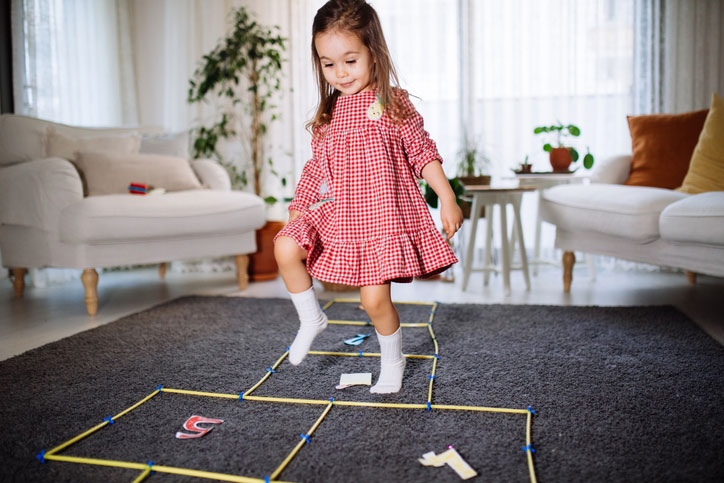
Set up: Create a hopscotch board using inexpensive, interlocking puzzle floor mats. Attach target words, sounds, or pictures to each hopscotch number.
Implementation: Encourage children to say the target word or sound each time they hop on a square. For language work, use category words (animals, foods, actions) and have children name items in that category, or use grammar targets like verb tenses.
Complexity Variation: For younger children, simple sound production with each hop is sufficient. For older children, require full sentences incorporating the target word.
Moving Right Along (Toy Cars and Language)
Toy cars provide excellent motivation for younger children while creating natural opportunities for language practice.
Set up: Create a roadway throughout the room using tape or yarn, making several “stops” along the route. At each stop, place a target word, sound, or sentence card.
Implementation: As children move their cars along the road and reach each stop, they practice the target at that location before moving forward. The goal of reaching the finish line maintains motivation through multiple productions.
Language Targets: Stops can include action words (with children demonstrating or describing actions), prepositions (placing cars “on,” “under,” “beside” objects), or sight words for emerging readers.
Exercises for Adult Speech Therapy
While pediatric therapy often dominates discussions of speech therapy exercises, adults recovering from stroke, traumatic brain injury, or managing progressive neurological conditions require specialized approaches. Adult speech therapy exercises focus on recovering lost abilities, maintaining current function, and developing compensatory strategies.
Post-Stroke Articulation Exercises
Adults recovering from stroke often experience dysarthria or apraxia of speech requiring intensive articulation practice.
Sound Repetition Drills: Unlike children who need game-like activities, many adults respond well to straightforward repetition drills. Practice target sounds in isolation (repeating “ta-ta-ta” 20 times), then progress to syllables, words, phrases, and sentences. The key is massive repetition—often 100+ productions per session for sounds affected by apraxia.
Minimal Pair Contrast: For adults with phonological errors, practice minimal pairs that differ by one sound (“bat” vs. “pat”). This builds awareness of subtle articulatory differences and helps retrain motor plans for speech production.
Cognitive-Communication Exercises
Adults with traumatic brain injury or right hemisphere stroke often need exercises targeting attention, memory, and language organization rather than articulation.
Sequencing Tasks: Practice putting steps in order for familiar activities (making coffee, starting a car). This rebuilds organizational skills needed for coherent communication.
Barrier Activities: One person describes an image or object while the other draws or builds it without seeing the original. This develops clear, precise, expressive language while revealing areas of communication breakdown.
Voice Therapy for Adults
Professionals who rely on their voices—teachers, salespeople, attorneys—often develop voice disorders requiring therapeutic intervention.
Resonant Voice Exercises: Practice producing voice with optimal resonance and minimal tension. Humming, then progressing to nasal consonants with vowels (“moo,” “nay”), helps establish efficient voice production patterns.
Vocal Function Exercises: This research-supported program involves four specific exercises: sustaining vowels at different pitches, pitch glides from low to high notes, and sustained high notes. Practiced twice daily, these exercises can improve vocal stamina and reduce vocal strain.
Safety Considerations and Best Practices
While speech therapy exercises are generally safe when implemented by trained professionals, certain considerations ensure client safety and maximize therapeutic effectiveness.
Medical Clearance Requirements
Before implementing certain exercises, particularly those involving oral motor work or swallowing-related activities, ensure appropriate medical clearance:
- Swallowing exercises: Require instrumental assessment (Modified Barium Swallow Study or Fiberoptic Endoscopic Evaluation of Swallowing) before implementation
- Respiratory exercises: May require pulmonologist clearance for clients with respiratory conditions
- Voice exercises: Laryngeal examination by ENT physician should precede voice therapy
- Oral motor exercises: Clients with structural abnormalities or oral sensory issues may need modified approaches
Aspiration Risk Awareness
Any activity involving food, liquid, or small objects requires careful monitoring, especially with:
- Children with known or suspected swallowing difficulties
- Adults with a history of aspiration pneumonia
- Clients with reduced alertness or attention
- Individuals with progressive neurological conditions affecting swallowing
When in doubt, avoid food-based exercises until swallowing safety is established through formal evaluation.
Monitoring Client Response
Watch for signs that exercises may be too challenging or inappropriate:
- Excessive frustration: Exercises should be challenging but achievable. If a client repeatedly fails despite effort, the task may be too difficult
- Physical discomfort: Oral exercises shouldn’t cause pain. If clients report soreness lasting more than a few minutes after exercise, reduce intensity
- Vocal strain: Voice exercises should never hurt. Hoarseness or pain during voice work indicates improper technique or excessive intensity
- Respiratory distress: Breathing exercises should never cause significant shortness of breath or lightheadedness
Home Practice Guidelines
When assigning exercises for home practice:
- Provide clear written instructions: Include specific targets, repetition counts, and frequency
- Demonstrate thoroughly: Show correct technique multiple times before expecting independent practice
- Set realistic expectations: Most home programs work best with 10-15 minutes daily rather than longer, less frequent sessions
- Build in accountability: Practice logs or apps help track compliance and progress
- Explain the “why”: When clients understand how exercises connect to their goals, compliance improves significantly
Infection Control
Many speech therapy exercises involve saliva contact with materials. Follow these guidelines:
- Individual supplies: Each client should have personal exercise materials (straws, bubbles, cards) when possible
- Sanitization protocols: Clean and disinfect all shared materials between clients according to facility guidelines
- Disposable options: Use disposable straws, tissues, and other single-use items when feasible
- Hand hygiene: Both clinician and client should wash hands before and after sessions involving oral contact
Frequently Asked Questions
Can I do speech therapy exercises at home without a speech pathologist?
While many speech therapy exercises can be practiced at home, they should only be implemented under the guidance of a licensed speech-language pathologist. An SLP must first assess your child or yourself to identify specific needs, rule out underlying medical conditions, and design an appropriate treatment plan. Home practice should always reinforce exercises introduced and monitored by a professional. Attempting exercises without proper assessment and guidance may reinforce incorrect patterns or miss serious underlying conditions requiring medical attention.
How often should speech therapy exercises be practiced?
Most SLPs recommend 10-15 minutes of daily home practice for best results. Research shows that frequency matters more than duration—short, consistent daily sessions produce better outcomes than occasional longer sessions. For pediatric clients, breaking practice into two 5-7 minute sessions (morning and evening) often works better than one longer session. Adults working on intensive goals like post-stroke recovery may practice 20-30 minutes multiple times daily. Always follow your SLP’s specific recommendations for your individual situation.
At what age should children start speech therapy exercises?
Evaluation can begin in infancy for children with identified concerns, like feeding difficulties, or children at high risk for communication delays. However, formal speech therapy typically starts around 18-24 months for most children with language delays. Articulation therapy usually begins around age 3-4 when children have developed sufficient attention and motor planning abilities for sound production work. Early intervention speech therapy focuses on age-appropriate communication goals. The key is early identification—if you have concerns about your child’s communication development at any age, seek evaluation from an SLP. Early intervention consistently produces better outcomes than waiting to “see if they grow out of it.”
How long does it take to see results from speech therapy exercises?
Timeline for progress varies significantly based on the type and severity of the disorder, frequency of therapy, home practice consistency, and individual factors. Simple articulation errors might show noticeable improvement in 8-12 weeks with consistent practice. More complex issues like childhood apraxia of speech may require 1-2 years or more of intensive therapy. Adults recovering from stroke often see the most rapid gains in the first 3-6 months post-injury. Your SLP should provide specific goals with anticipated timelines during your evaluation and treatment planning. If you don’t see any progress after several months of consistent therapy, discuss this with your SLP to evaluate whether modifications are needed.
Are speech therapy exercises covered by insurance?
Coverage varies widely by insurance plan and the reason for therapy. Most insurance plans cover speech therapy when it’s deemed medically necessary, meaning the condition impacts health, safety, or function. Medicare covers speech therapy for adults following a stroke, traumatic brain injury, or other qualifying medical events. For children, Early Intervention services (birth to 3 years) are often covered through state programs regardless of insurance. School-age children may receive therapy through their school district if the speech issue impacts educational performance. Private insurance coverage varies—always check your specific plan for speech therapy benefits, session limits, and copayment requirements. Many families find that combining school services, insurance-covered private therapy, and home practice provides optimal outcomes.
What’s the difference between a speech therapist and a speech-language pathologist?
There’s no difference—these terms refer to the same professional. “Speech-language pathologist” (SLP) is the official professional title, while “speech therapist” is the more common public term. Both require a master’s degree, supervised clinical experience, passing the national Praxis examination, and state licensure. Some states also have Speech-Language Pathology Assistants (SLPAs) who can provide therapy under SLP supervision but have less education (typically a bachelor’s degree or certificate program). When seeking services, always verify that your provider is a licensed SLP with their Certificate of Clinical Competence (CCC) from ASHA. You can learn more about how to become a speech-language pathologist on our site.
Can adults improve their speech with therapy exercises?
Absolutely. Adults can make significant improvements through speech therapy exercises, though the timeline and approach differ from pediatric therapy. Adults recovering from stroke or traumatic brain injury often see substantial gains, especially when therapy begins early. Those with longstanding articulation patterns (like a persistent /r/ or /s/ distortion) can successfully modify these patterns in adulthood, though it requires intensive, consistent practice. Adults with voice disorders from professional voice use, injury, or surgery frequently achieve complete recovery or significant improvement. The adult brain’s neuroplasticity means learning and change remain possible throughout life, though it may require more intensive, systematic practice than in childhood. Many adults find that their motivation and understanding of the therapeutic process actually give them advantages in therapy compared to younger clients.
Key Takeaways
- Speech therapy exercises are evidence-based activities designed to improve articulation, language, voice, and communication skills under professional supervision
- Effective pediatric exercises combine therapeutic goals with engaging, game-like activities that make repetitive practice feel like play
- Articulation and phonology exercises use creative approaches like lily pad hopping, bean bag tosses, and treasure hunting to achieve the high repetition needed for motor learning
- Oral motor and breath control exercises strengthen the muscles and coordination required for clear, effortless speech production
- Adult speech therapy focuses on post-stroke recovery, voice rehabilitation, and cognitive-communication skills, with approaches tailored to adult learning styles
- Home practice of 10-15 minutes daily, assigned by your SLP, significantly accelerates progress and improves long-term outcomes
- Safety considerations include obtaining proper medical clearance, monitoring for aspiration risk, and following infection control protocols
- Always work with a licensed speech-language pathologist for assessment, treatment planning, and ongoing monitoring—never implement exercises without professional guidance
- Emerson College - Master's in Speech-Language Pathology online - Prepare to become an SLP in as few as 20 months. No GRE required. Scholarships available.
- Arizona State University - Online - Online Bachelor of Science in Speech and Hearing Science - Designed to prepare graduates to work in behavioral health settings or transition to graduate programs in speech-language pathology and audiology.
- Pepperdine University - Embark on a transformative professional and personal journey in the online Master of Science in Speech-Language Pathology program from Pepperdine University. Our program brings together rigorous academics, research-driven faculty teaching, and robust clinical experiences, all wrapped within our Christian mission to serve our communities and improve the lives of others.
- Aurora University - BS Communication Sciences and Disorders program - Discover how to transform lives by identifying and treating communication disorders for people of all ages. You’ll gain hands-on experience while fulfilling requirements toward graduate education.
- Arkansas State University - Dyslexia Certificate - Build upon your teaching expertise by adding a specialization in dyslexia with their Dyslexia Certificate online program.
- Eastern Oregon University - Master of Science in Education with a specialization in Dyslexia - Provides an advanced study of best practices and applications for PK–12 contexts with a specialization in Dyslexia.
- The University of West Alabama - Master of Education in Dyslexia Therapy - Enter an emerging field to support students with dyslexia and related reading challenges by earning your MEd in Dyslexia Therapy degree.
Ready to Start Your SLP Career?
Helping clients regain communication abilities or develop new speech skills requires specialized education and clinical training. Speech-language pathologists combine scientific knowledge with creative therapeutic approaches to make meaningful differences in people’s lives every day.
Related Resource: Top 5 Alternative and Complementary Modalities to Pair with Speech Therapy